Start Here
Buying $1,000 of crypto costs $19 more through Buy Crypto than on the spot market
Same purchase, two routes. Buy Crypto charges by payment method — 2% on a card. Spot trading charges a Regular User 0.100%. On $1,000 that is $20 against $1.
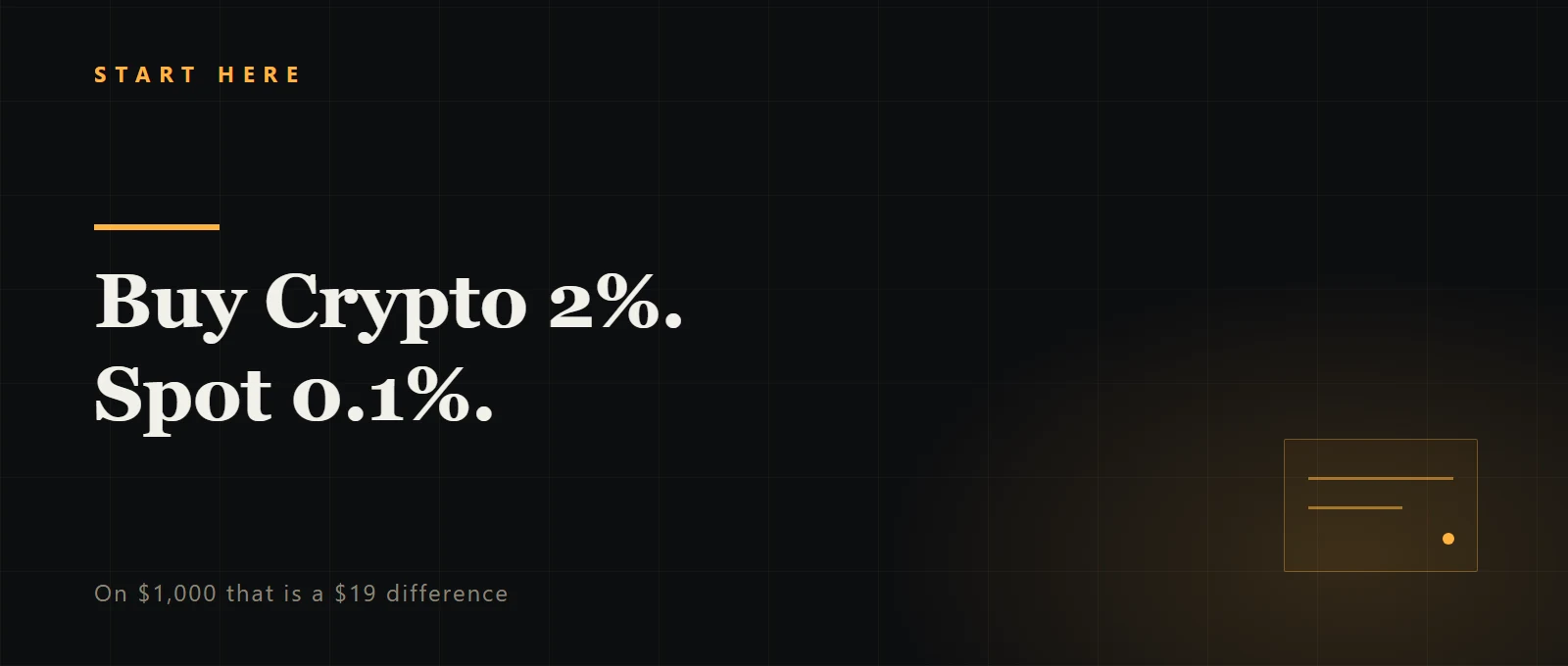
There are two ways to end up holding crypto on Binance: the Buy Crypto button, and an order on the spot market. They differ in difficulty, and they differ far more in price — Buy Crypto with a card costs 2%, while spot trading costs a Regular User 0.100%. That is a twenty-fold gap.
On a $1,000 purchase: $20 through Buy Crypto, $1 through spot. The ratio holds at any size. Both numbers below come straight from the official fee page.
Spot trading: 0.100% maker and taker for a Regular User
On the fee page, under Trading → Spot & Margin, the first row is the one that applies to a new account: 30-day trade volume under 1,000,000 USD or a BNB balance of 0 or more, maker/taker 0.100% / 0.100%.
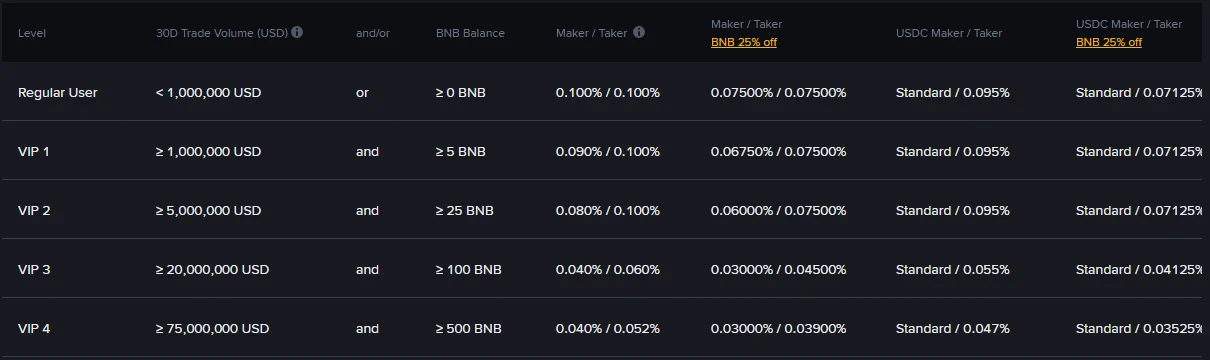
The next column along is the price with the BNB discount applied — labelled BNB 25% off — which brings it to 0.07500% / 0.07500%. VIP 1 below it needs 30-day volume of at least 1,000,000 USD and at least 5 BNB held, so for a new account the first row is the only one that matters.
Buy Crypto: priced by payment method, 2% on a card
Switch to the Buy/Sell tab and the logic changes completely. Volume is irrelevant; what matters is how you pay:
- Card (Visa/Mastercard): 2%
- Apple Pay: 2%
- Google Pay: 2%
- PayPal: 1.5%
- Revolut: 1.1%
- Sepa (euro bank transfer): 1 EUR
Selling back carries the same structure: card, Apple Pay and Google Pay at 2%, PayPal at 1.5%, Sepa at 1 EUR.
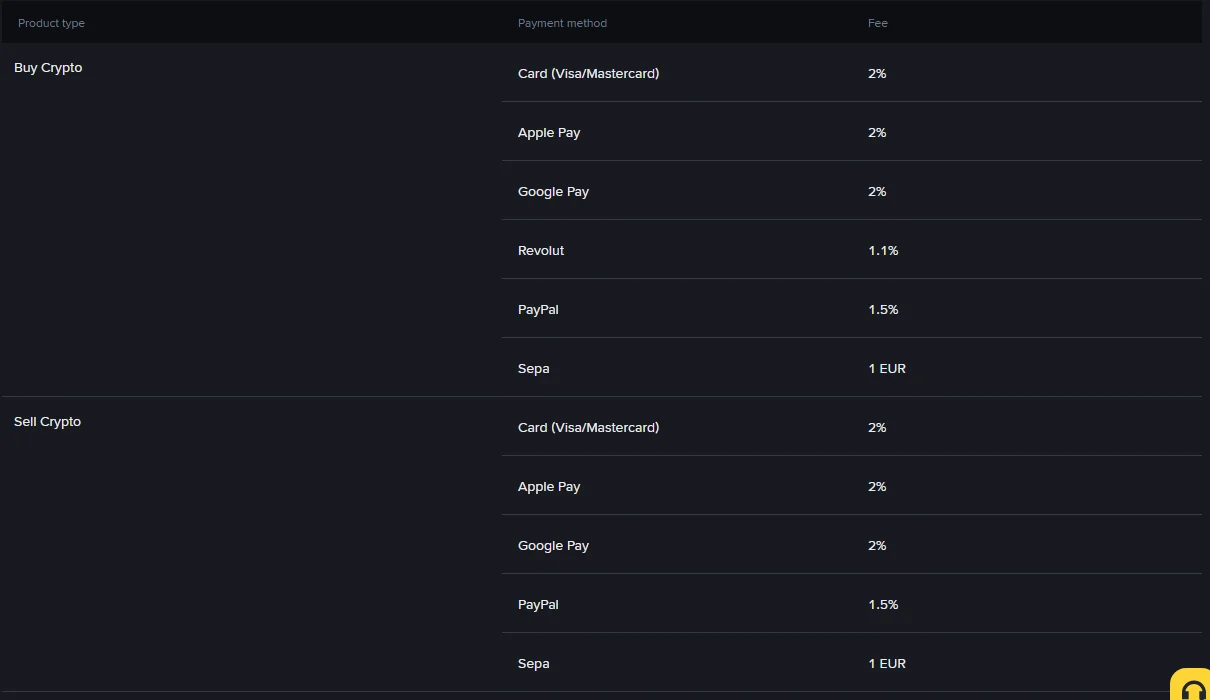
Notice that Sepa is a flat 1 EUR rather than a percentage — the only line on the table that does not scale with the amount, which makes it progressively better the more you buy.
What $1,000 actually costs on each route
- Buy Crypto, card at 2%: 1,000 × 2% = $20
- Spot, taker at 0.100%: 1,000 × 0.1% = $1
- Spot with the BNB discount at 0.07500%: 1,000 × 0.075% = $0.75
That is a $19 gap against the plain spot route and $19.25 against the discounted one. At $100 the gap shrinks to $1.90 in absolute terms — still $2 versus $0.10.
These are fees only. What you actually receive also depends on the price you are filled at: a quoted rate in Buy Crypto, the order book in spot. Neither of those appears on the fee table, so read the estimated amount on the order screen before confirming.
So is Buy Crypto ever worth it
Yes. What it sells is the removal of steps: no funding first, no order book, no maker-versus-taker decision. Enter an amount, receive crypto. For a first purchase, a small amount, or simply proving the pipeline works end to end, 2% buys a route where little can go wrong.
Once you are buying regularly, or putting in four figures at a time, that spread is worth reclaiming: fund the account with fiat or P2P first, then place a spot order and pay 0.1%.
When these numbers change
Three situations. Your 30-day volume or BNB balance crosses a VIP threshold. You switch the BNB discount on or off. Or Binance revises the schedule or runs a promotion. The first two show up on your own fee page; the third only shows up on the official page at the time.
So treat every figure here as dated rather than permanent — during promotions in particular, what gets deducted may not match this table.
Where the numbers come from
The spot rates and the BNB 25% discount come from the Trading → Spot & Margin table on the Binance fee rate page; the Buy Crypto and Sell Crypto rates come from the Buy/Sell tab on the same page. Both were opened and read on 19 September 2026, and the two screenshots are from that session. The three calculations above apply those rates directly.
The two steps before any of this — registration and verification — are in Binance sign-up: the four entry points and Four details that get your Binance verification rejected; the full sequence is in What actually happens between signing up and owning your first crypto.