Start Here
Withdrawing USDT over TRC20 costs 1.5; over BEP20 it costs 0.01
TRC20 is the reflex choice, and right now it is the most expensive USDT network on Binance — 150 times the BEP20 fee. But price is not the first question to ask.
Withdrawing USDT means picking a network, and most people reach for TRC20 without thinking. On Binance's current schedule that reflex is expensive: TRC20 costs 1.5 USDT per withdrawal, BEP20 costs 0.01 — a factor of 150.
That does not make "always pick BEP20" the answer. Send coins over a network the receiving side does not support and recovering them is uncertain at best. So the order is the other way round: confirm what the destination accepts, then choose the cheapest network both sides support. Here is today's full picture.
Today's fees: 19 networks, from 0.01 to 1.5
Sorted by withdrawal fee, the ones you are likely to meet:
| Network | Fee per withdrawal | Confirmations |
|---|---|---|
| BNB Smart Chain (BEP20) | 0.01 USDT | 1 |
| Plasma | 0.012 USDT | 1 |
| opBNB | 0.015 USDT | 1 |
| AVAX C-Chain | 0.04 USDT | 12 |
| Optimism | 0.04 USDT | 25 |
| Polygon POS | 0.07 USDT | 200 |
| Arbitrum One | 0.1 USDT | 120 |
| Ethereum (ERC20) | 0.3 USDT | 6 |
| Solana | 0.3 USDT | 1 |
| The Open Network (TON) | 0.3 USDT | 1 |
| Tron (TRC20) | 1.5 USDT | 1 |
Minimum withdrawal is 5 USDT on most networks; BEP20, Aptos, Arbitrum, Optimism and TON allow 3.
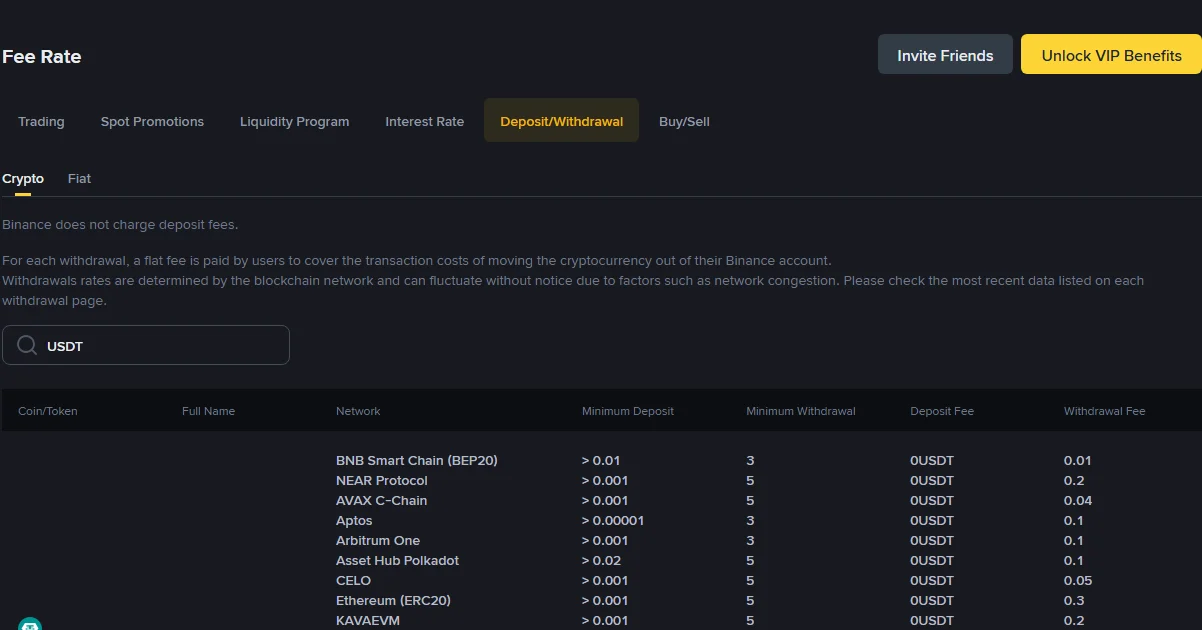
The deposit side works differently, and the page says so outright: "Binance does not charge deposit fees." Moving crypto into Binance costs you the sending network's fee, nothing to the platform.
Why TRC20 ends up the most expensive
This is not Binance pricing one chain above another. The same page explains: "For each withdrawal, a flat fee is paid by users to cover the transaction costs of moving the cryptocurrency out of their Binance account," and "Withdrawals rates are determined by the blockchain network and can fluctuate without notice due to factors such as network congestion."
So the number tracks the chain's own cost and moves with it. TRC20 being expensive today says nothing about next month, and BEP20 being cheap today is not a guarantee either. Glancing at the live rate before each withdrawal beats memorising a conclusion.
Two things that matter besides price
Confirmations. That column varies wildly: BEP20, Solana, TON and TRC20 clear in 1 confirmation, Ethereum takes 6, Optimism 25, Arbitrum 120, and Polygon POS needs 200. More confirmations is not less safe, it just takes longer to land. When you are in a hurry, this column matters more than the fee.
Whether the other side accepts it. A receiving address belongs to one network. Send BEP20 funds to an address that only recognises TRC20 and you are filing a recovery request with no promised outcome. Check what the destination asks for before you open the withdrawal page, not after.
Some networks are switched off right now
One thing the fee table cannot tell you: a network may have withdrawals temporarily disabled. Checked today, Kaia is closed for USDT withdrawals (deposits still work), yet the fee table still lists its 0.02.
The fee page answers "how much", not "is it available right now". The withdrawal page itself is what shows which networks you can actually pick — unavailable ones are greyed out or simply absent.
A sequence that keeps the cost down
- Check which network the receiving side wants, and narrow to what both sides support.
- Among those, weigh the current fee against the confirmation count — cheap versus fast.
- The first time you use a network, send a small test amount and confirm it arrives.
- Watch the ratio on small amounts: withdrawing 10 USDT over TRC20 means 1.5 in fees, or 15%.
Where the data comes from
The fees, minimum withdrawals and confirmation counts come from the Binance fee rate page under Deposit/Withdrawal → Crypto with USDT in the search box, cross-checked against Binance's public network-information endpoint; both sources matched. The quoted sentences are from that same page. Data read on 20 September 2026, and the screenshot is from that session.
Rates float with network costs, so every figure above is a snapshot. The cost comparison on the buying side is in Buy Crypto versus spot fees, and the whole path from signing up is in What actually happens between signing up and owning your first crypto.